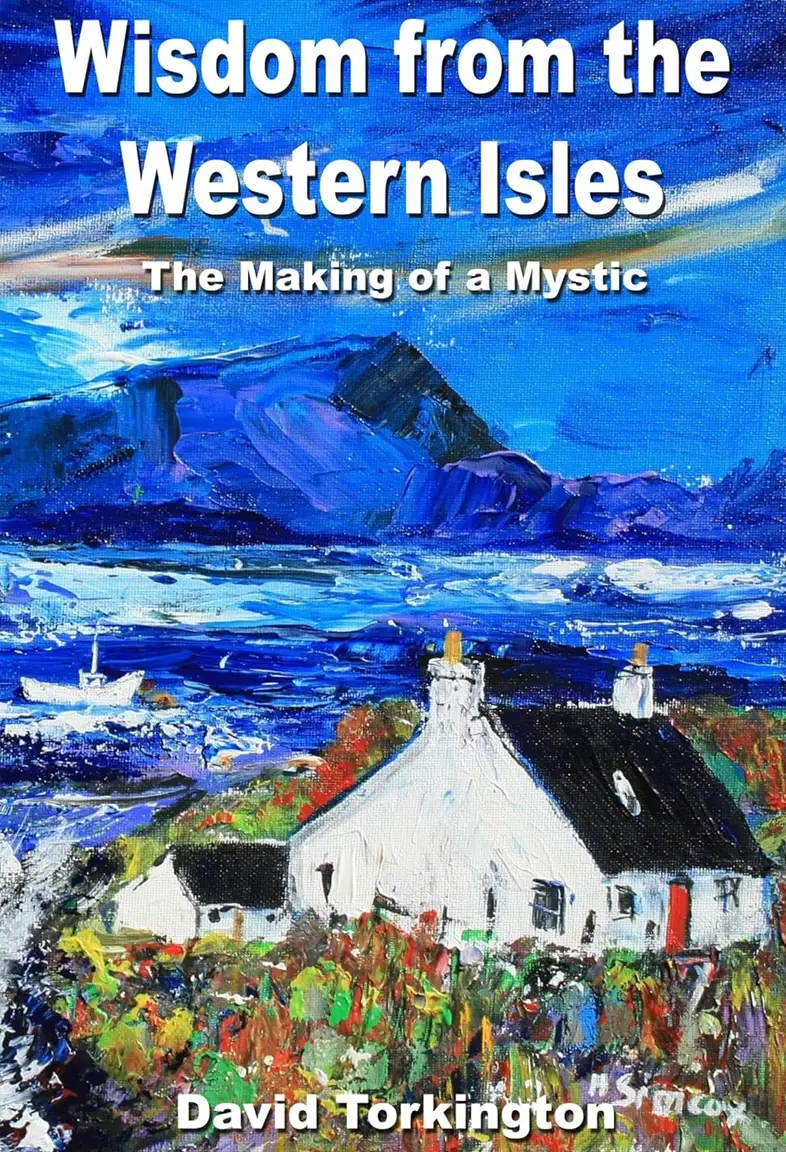
After losing his wife in childbirth, young American James Robertson visits spiritual director, Peter Calvay, who lives in the Outer Hebrides.
At first James learns how to pray and how to meditate.
Then when Peter is lost at sea, James finds details of Peter’s own spiritual journey that inspires James to deepen his own spiritual life.
As well as practical advice on prayer this part describes the deeply human story of the young woman with whom Peter falls deeply in love.
Eventually Peter is found alive and the two men meet on the mainland at Peter s mother’s funeral.
Peter uses the teachings of the Cloud of Unknowing, St John of the Cross and St Teresa of Avila as well as the paradigm of his own parent’s love for each other to explain the mystic life.
Deeply moving lessons are drawn for those committed to paths that can lead to the fullest possible experience of love here on earth.
Wisdom from the Western Isles is still currently being read on Czech republic radio broadcasts and is mandatory reading for youth groups in the Slovenian language.
Extract from Wisdom from the Western Isles
Chapter 2
Peter looked in his late thirties, or possibly forty, but even my arithmetic told me he must be at least forty two.
I would say he had worn well, in spite of the telltale grey hairs, which were by no means abundant. A handsome man, no doubt about that. This was something I’d not expected either. It was a strong face with a touch of stubbornness about the chin, but the face had been softened through suffering, and was mobile with compassion.
He wore a large donkey jacket, heavily patched with genuine leather at the elbows. Perhaps it was the thick white Arran sweater underneath that gave him such a heavy, powerful appearance. His trousers were strong black ‘cords’, and his right foot was supported by a large built-up boot, fitted to an iron caliper; oddly enough, he was wearing a massive homemade sandal on the other.
‘If you don’t mind, James,’ he said, breaking out into another guilty smile, ‘I’d prefer to have a bath. Father Callum usually lets me have one each Sunday before dinner, so I’ve just got time if I go now.’
‘By all means,’ I said. ‘We’ll meet in half an hour for dinner, if that gives you enough time?’
‘Plenty, thanks,’ he replied. ‘It won’t take me long.’ He picked up an old sports bag, took his stick, which had been hanging over the back of the chair, and went upstairs.
I sat down with a sigh of relief. The worst was over; the introductions were done.
Wisdom from the Western Isles Reviews
One gains the immediate impression on taking up these books that they are not some glib response to an editorial suggestion but rather something carefully meditated. Torkington writes about prayer and one feels that he writes from experience, with the authority of one who has prayed.
The hermit in question is Peter Calvay, who lives off the island of Barra in the Hebrides.
The narrator is in pursuit of Peter and his knowledge of prayer. When the two meet, various conversations ensue and, with Peter as our guide, we are taken on a tour from the depths of semi-Pelagianism to the heights of mystical experience, encountering some serious spiritual theology on the way.
Torkington has the happy knack of marrying style and content. At no time do we think this is a prayer manual dressed up as a novel, the novelistic trappings being the honey to snare the flies.
Rather, we realise that prayer isn’t simply a matter of theory, but something to be lived — and these books succeed in presenting theology as lived experience.
In an age such as ours where faith and life are so dangerously divergent, this is a considerable achievement.
Torkington’s books may well end up on the shelf marked “Popular Theology.”
This is a little unjust, as these books are far from simplistic; indeed, they are a welcome antidote to modern ignorance.
But St. Francis de Sales wrote “popular” works too, and if these books end up next to Introduction to the Devout Life, they will be in fitting company.
David McLaurin Winner of the “Daily Express Book of the Year Award” for his novel Bishop of San Fernando.
David Torkington’s book, has the format and flow of a novel but the impact of a work of deep mysticism.
The story itself is intriguing, and includes a genuine ‘Blue-Print for Prayer’ (and an explanation of how best to use it) that is powerfully practical.
This little book can revolutionize the way you pray. To get better at doing ‘the most important thing’ in your life, we recommend you read this book.
Larry Holley O.S.B in Book Nook, Dove Publications, Pecos, NM. USA
An adventure in serious prayer life: Reading like a rambling, atmosphere-filled 19th Century English novel: A thought-and-action-for-prayer packed trilogy from Torkington.
Filled with journeys, island-seaside-and-urban vistas, the English language artfully employed, British wit at its best, deft insight into the essential human quest for intimacy with God.
Filled with insights into spiritual growth and the options for meeting God in daily prayer. By itself, it may just bring back the written word, at least in terms of spirituality.
Crux of the News (USA)
I thought this book did an excellent job of outlining the spiritual adventures involved in seeking a relationship with God.
Though the narrative is told in first person for the most part, it incorporates several points of view and experiences through letters and stories.
This is not for readers looking for a quick thrill or fast action. More appropriately, this is a wonderfully meditative encounter with the stages of prayer leading toward a closer union with God.
I found much of what Mr. Torkington said to be amazingly true. Like C. S. Lewis, I felt I was discovering truth again, but in a new light, from a fresh approach that helped (and will probably help me for years to come) to step a little closer God, or rather, to let God reveal His constant presence to me.
As someone once said, “If you have lost God, it is not God who is lost.” This book helps to point the reader’s spirit in the right direction.
Ann Frailey Amazon Reviewer
I had read “The Hermit” before and was pleased to find three of David Torkington’s books condensed into one volume.this is a book I shall refer to again and again and am grateful you have been able to get this to me- Grateful thanks.
Stella Ray Amazon Reviewer
Mysticism is a frequently misunderstood word. It is sometimes presented as a modern phenomenon coming solely from the East and entering our Western world under the guise of the occult.
In a beautiful, personalized portrait, the author depicts a real person delving into the depths of the human condition.
It reveals a practice deeply imbedded in the original Wisdom of the Judeo/Christian tradition.
This is a must read for both initiates to the subject and as a teaching method for those tasked to direct others.
Paul J Williams Amazon Reviewer
The original (and brilliant) trilogy (Hermit, Prophet, Mystic) has now been rewritten as a single book “Wisdom from The Western Isles” (with ‘raconteur’ changed from a Catholic Priest to an Episcopalian layman.)
There is now a sequel to ‘Western Isles’ – “Wisdom from Franciscan Italy”. All are great; with teaching on the mystic pathway (Western Isles) and Franciscan Spirituality (Franciscan Italy) being presented in the form of a novel.They are not dry and dusty ‘academic’ studies but are vibrant and alive. If you struggle with prayer (as most people do) then give these books a try.
John – Kidderminster Amazon Reviewer
David Torkington’s Trilogy on Prayer immediately reminds one of that rich tradition which stretches back to the first days of the church and moves on through the Middle Ages with masters like William of Saint Thierry and reaches into our own century in such works as the masterful Three Ages of the Spiritual Life of Garage-LaGrange.
That rich tradition which stretches back to the first days of the church and Origen, moves on through the Middle Ages with masters like William of Saint Thierry and reaches into our own century in such works as David Torkington’s Trilogy on Prayer immediately reminds one of the masterful Three Ages of the Spiritual Life of Garage-LaGrange.
Indeed ‘three ages of the spiritual life’ might be the best way to sum up Torkington’s volumes. The first,
The Hermit, gets us started on the journey, inculcating basic openness to God through humility, listening to the Scriptures and practising the other virtues.
The second, The Prophet, drawing from monastic and Franciscan spirituality, moves us along from conversion and repentance to openness to the mystical life.
And it is the third, The Mystic, which gives the reader a quick over-view of the teaching of St. John of the Cross with some helpful practical applications. But Torkington’s three-part presentation is no ponderous tome. Rather these slim volumes – which form a whole and are to be read in order – delightfully use the vehicle of story so dear to the Lord himself and increasingly popular in our time. And David Torkington, an experienced lecturer and retreat master, is a good storyteller – [This] threefold journey is a refreshing experience, enlightening and promising, and calls us to the living, for the proof of the pudding is in the eating.
M. Basil Pennington O.C.S.O. in America